I’m visiting the William Lindesay family in China for two weeks as they take me to points all along the entire Great Wall. You can read the backstory at my website or here on my blog along with all my posts while in China.
Jiayuguan, China
Tuesday, September 22, 2026
11:40 PM
Updated 9/25/26
Note: I have received a large collection of professional photographs taken this day — too many to include in this post. There will be a follow up after returning home which I will link here.
Once again this has been a day for the record books. Today we visited the Fortress of Jiayuguan where my grandfather, William Edgar Geil, stayed for two days in August 1908 as he concluded his historic traverse of the Great Wall. Moreover I stood on several precise spots where he stood as documented in photographs of the time. The power of this experience cannot be overstated.
The Fortress at Jiayuguan
The Fortress at Jiayuguan formed a critical barrier to invasion at the western-most end of the Ming Dynasty Great Wall. There are many other walls in China, but it is the Ming Wall that is commonly considered “The Great Wall of China.”
My grandfather, his team and their mules were sheltered and fed here at the Fortress for two days from August 21-23, 1908.


There are several photographs either showing William Geil at the Fortress or that were taken by him. Some are in his book The Great Wall of China. Visiting today with camera crews again in tow, William Lindesay and I focused on these photos.
One photo showed my grandfather entering the Fortress at exactly the spot William and I posed for this photograph:

Another photograph was taken of Geil in a kind of shed. That shed is nowhere to be found, because it’s gone. But we see now where it was located — at the base of one interior corner — and I stood there.

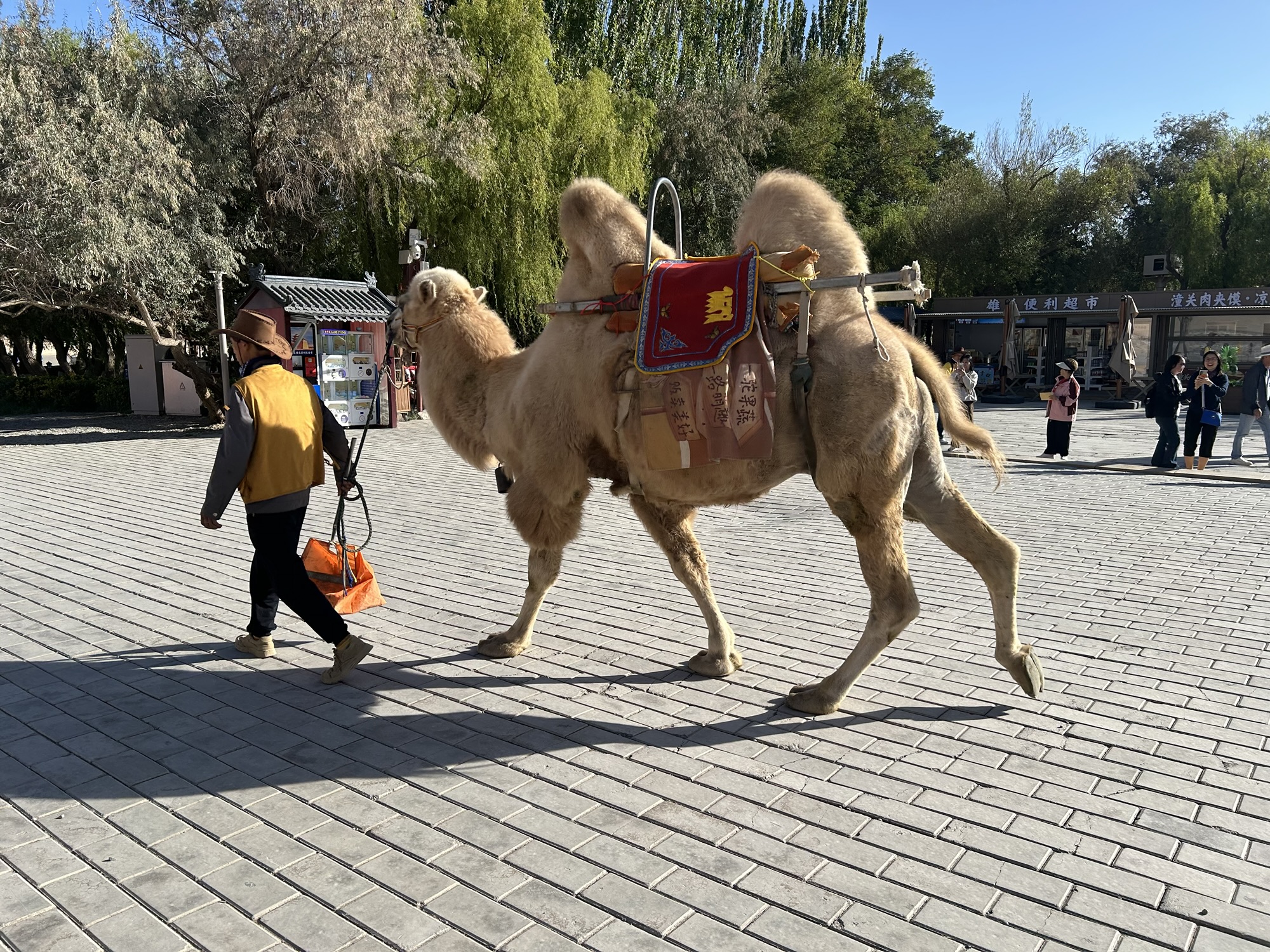
Just to make things interesting, a camel walked through while we were in the Fortress. (See the title image at the top of this post.)
Jiayuguan Museum of the Great Wall
Adjacent to the Fortress is the Jiayuguan Museum of the Great Wall.

We participated in a ceremony honoring and thanking the museum for its work, presenting it with a plaque. In return we received gifts in recognition of William’s work and the contribution of my family in donating Geil’s archive to William Lindesay and the International Friends of the Great Wall.


The Western Terminus of the Great Wall
My grandfather walked the Great Wall from east to west. When he entered Jiayuguan in the west and reached the Fortress, he thought was done. He’d reached the end. But wait, not yet!
Looking out from the Fortress the Wall can be seen extending a bit further west.

So Geil continued his journey a bit longer, continuing his walk to the Taolai River gorge where the Great Wall finally ends. There he was photographed looking at the very last watchtower, or the remnants thereof.

William and the camera crew positioned me to stand on the exact spot Geil is shown standing in 1908. This picture of me was taken from a different spot than the original, so it appears wrong but the official recreation is good.

The watchtower, by the way, is deteriorated but its condition and appearance is virtually unchanged from what Geil saw in1908.
[I plan an update to add more soon.]
The Wall Looks Different Here
As the Great Wall extends thousands of miles from east to west, it’s built of different materials in different areas due to the varied conditions and resources in each area. The Wall isn’t all like the familiar brick and stone we see in most pictures. In the final miles at Jiayuguan it’s built of “rammed earth.”
I think most people wouldn’t initially realize this is part of the same Great Wall we know back near Beijing.


While walking out to the final terminus of the Wall, we enjoyed this fun sight :
And, to close the day, we all enjoyed a genuine Chinese dinner.


Leave a Reply